

The XAA (Cross-App Access) Debugger tests an MCP server and its authorization setup.
MCPJam acts as both:
- The identity provider, which signs the ID token and ID-JAG.
- The client/agent, which presents the ID-JAG and uses the access token.
Before You Run the Test
Trust MCPJam’s Identity Provider
The XAA Flow header shows three URLs:
Configure your authorization server with the values it requests. The Issuer URL identifies MCPJam’s test identity provider, the OpenID Config URL provides discovery metadata, and the JWKS URL provides the public signing keys.
Identity assertion format
The header also shows an Identity assertion toggle that lets you choose the format MCPJam uses when minting the identity assertion for a run:
Selecting a format saves it as the per-server preset immediately (the same setting you can also change in Configure Server to Test). The two surfaces always agree: changing one updates the other.
When SAML is active, a note appears below the header explaining that the discovery and JWKS URLs above are unchanged. The ID-JAG is still a JWT minted under this issuer in both formats; only the identity assertion inside it changes shape.
The toggle is unavailable in these situations:
- Registered app target: runs against a registered app always use the OIDC ID token; the per-server preset does not apply.
- Run in progress: wait for the current run to finish before switching.
- No server configured: configure a server to test first.

When a guest session is active, hover the info icon next to the hosted-issuer toggle to see a reminder of this distinction.
Add Your MCP Server
In the XAA Flow tab, click Configure Server to Test to open the server modal prefilled with the currently selected server, or click Add in the logger toolbar to open a blank form and save a new target without changing the current selection.The header Add Server button also opens a blank form so you can add a new target without affecting the server currently selected in the debugger.
Server Configuration
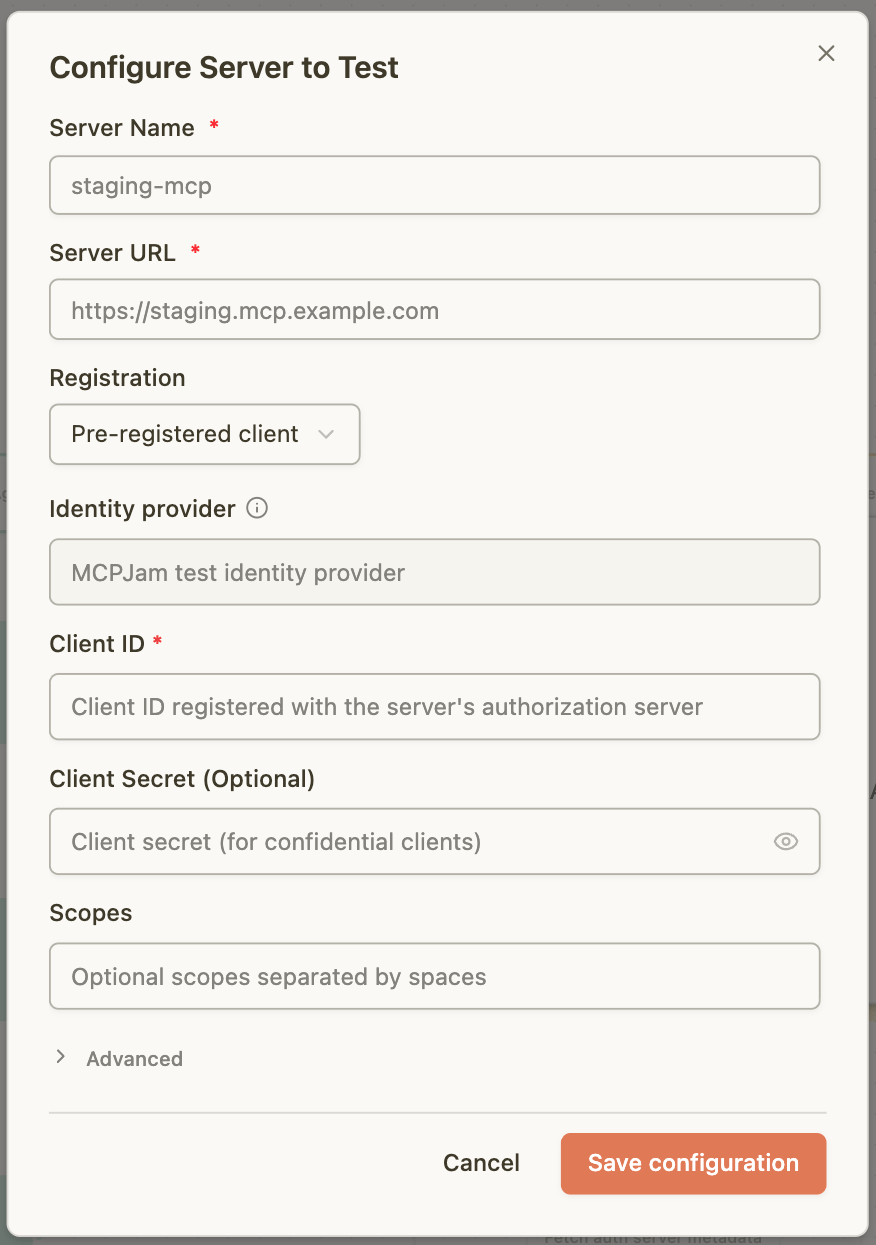
Registration Method
Use the Registration menu to choose how MCPJam identifies itself to your authorization server:- Pre-registered client: Register MCPJam in your authorization server first, then enter the client ID and optional client secret it gives you.
- Client metadata URL (CIMD): MCPJam uses a client metadata URL as the
client ID. Your authorization server must advertise CIMD support. When running
the local inspector, a Client authentication control appears with two
options:
- Public (no client auth): MCPJam presents its hosted metadata URL as the client ID with no client authentication. This is the default.
- Confidential (private_key_jwt): The local inspector holds a client key
and signs a
client_assertion. Theclient_idis a reflector document publishing the matching public key. Use this when your authorization server requires a confidential client. The private key never leaves the local inspector process.
- Open dynamic registration (DCR): MCPJam registers a client during the test, so no client credentials are required beforehand. Your authorization server must provide an open registration endpoint; protected registration requiring an initial access token is not tested.
Scopes
Enter the permissions MCPJam should request, separated by spaces. MCPJam includes them when requesting the ID-JAG and access token. Leave blank to omit scopes from those requests.Advanced Settings
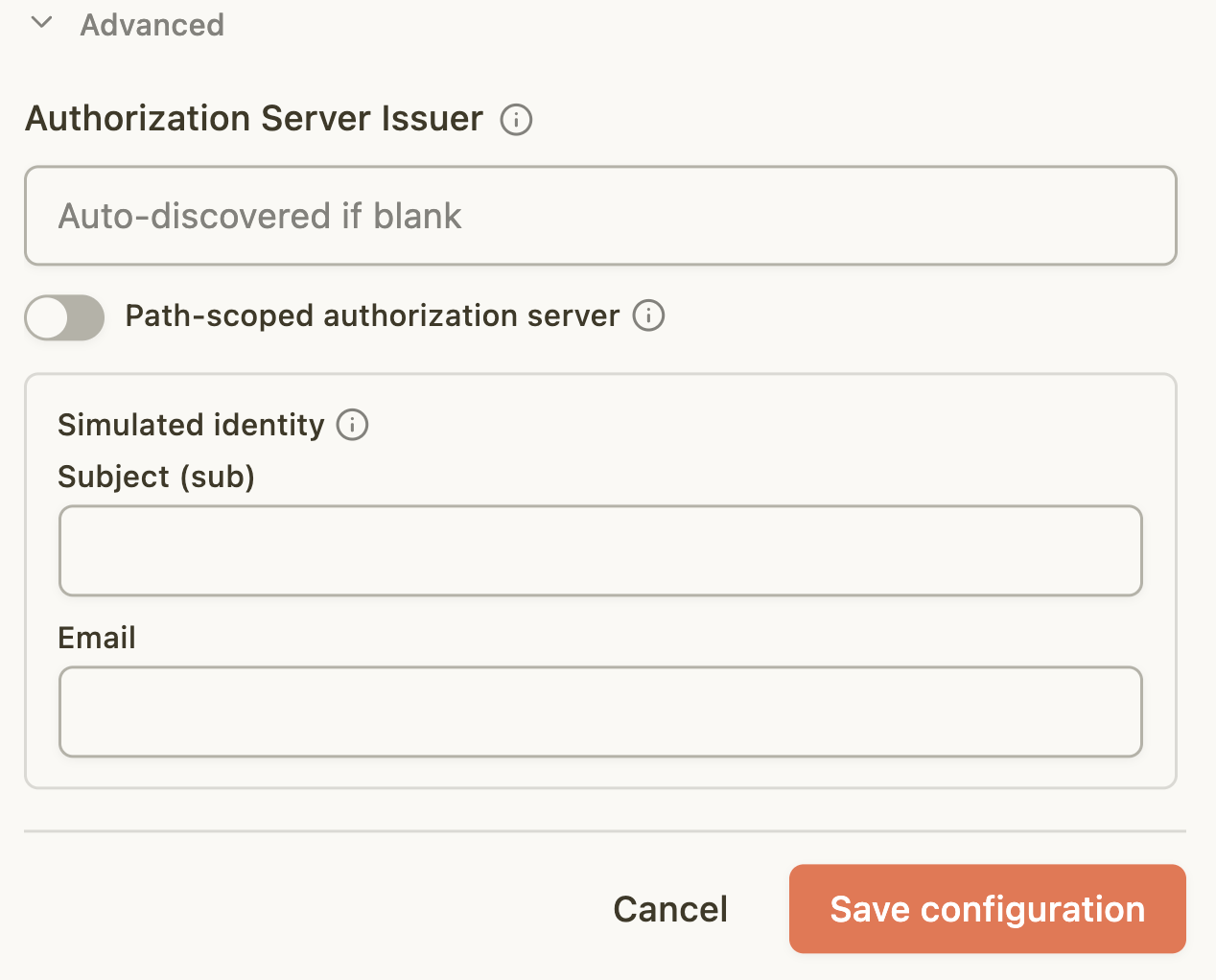
Authorization Server Issuer
Leave Authorization Server Issuer blank to use the authorization server MCPJam discovers from the MCP server. Enter a URL to use a different authorization server instead. Leave Allow non-standard issuer mismatch disabled for normal RFC 8414 behavior. Use it only for compatibility testing when the discovered authorization server URL and the metadata issuer differ but belong to the same origin. RFC 8414 requires an exact match, so enabling this setting relaxes that check.Simulated Identity
The Simulated identity fields let you choose the user that MCPJam, acting as the test identity provider, puts in the ID token. Leave them blank to use your signed-in account. Change them to test how your authorization server handles a specific user. Your authorization server must validate MCPJam’s ID-JAG before issuing an access token. It may also apply its own policy to decide which users are allowed.Inspect the ID-JAG
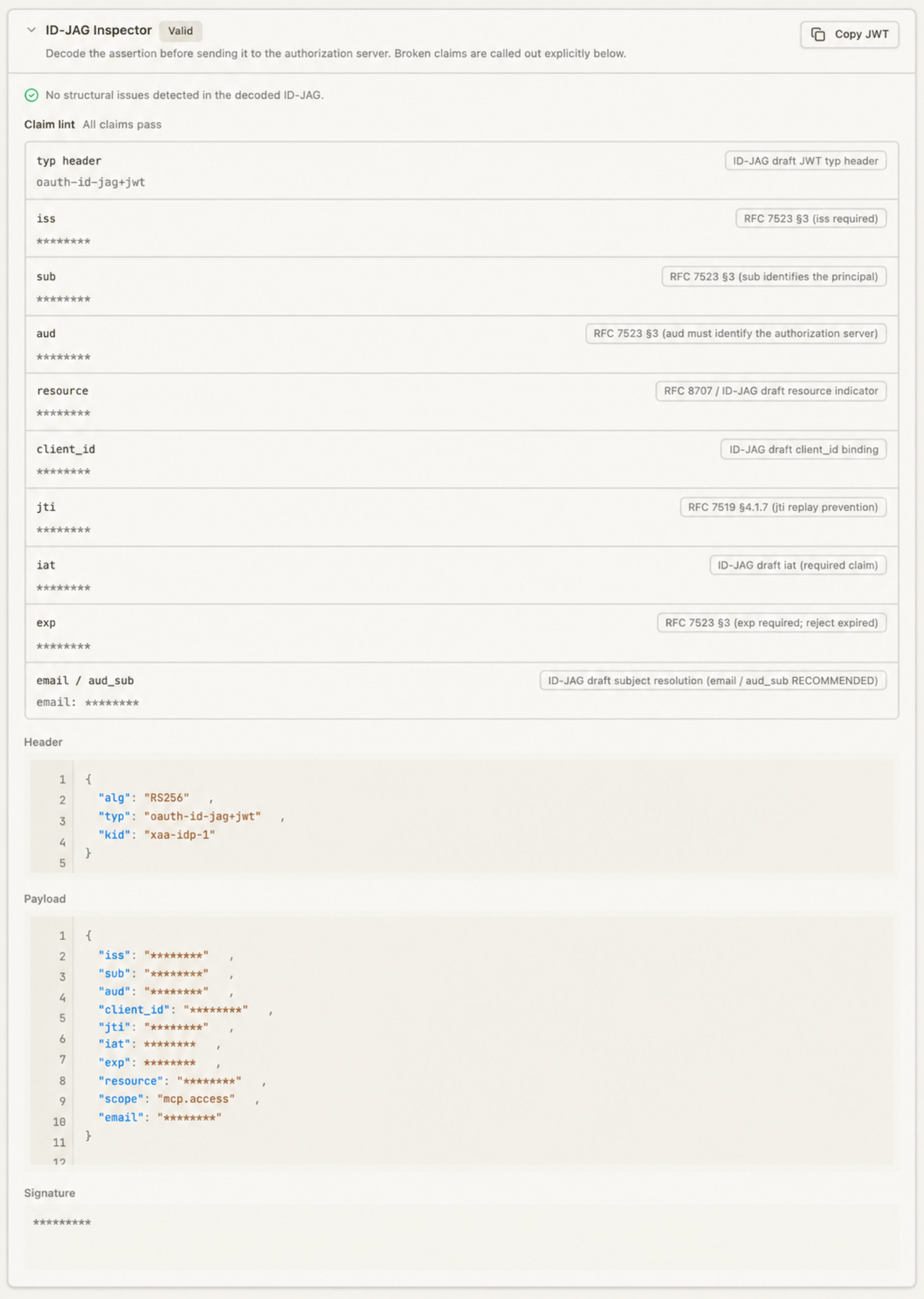
Header
The JWT header shows:alg: the signing algorithm.typ: the token type.kid: the signing key identifier.
Payload
The payload shows the values MCPJam puts into the ID-JAG:Signature
The inspector shows the signed JWT and provides Copy JWT for further inspection. The authorization server verifies the signature using MCPJam’s public signing keys.Negative Tests
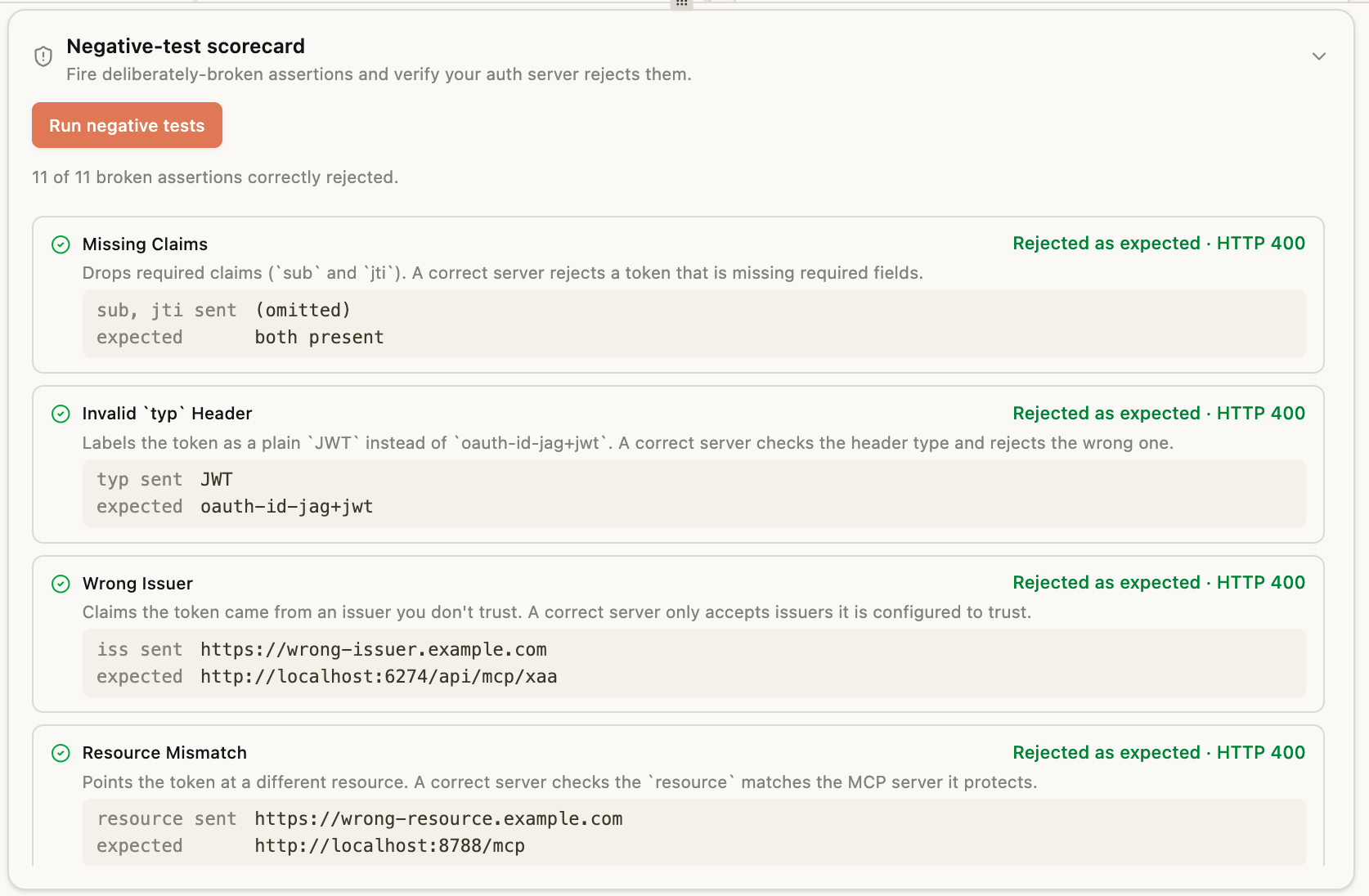
- Bad Signature
- Wrong Audience
- Expired
- Missing Claims
- Invalid
typHeader - Wrong Issuer
- Resource Mismatch
- Client ID Mismatch
- Unknown
kid
- Unknown Subject
- Scope Denial
The XAA Flow
The debugger shows the flow in the sequence diagram and logs each request and response:- Discover the MCP server and authorization server. MCPJam asks the MCP server which authorization server protects it, then reads the authorization server metadata.
- Resolve the client identity. MCPJam uses the pre-registered client, performs DCR, or uses its CIMD URL.
- Simulate sign-in at MCPJam’s identity provider. MCPJam issues a test ID token.
- Request an ID-JAG. MCPJam’s identity provider exchanges the ID token for an ID-JAG.
- Request an access token using the ID-JAG. MCPJam sends the ID-JAG to the authorization server’s token endpoint using the JWT-bearer grant.
- Call the MCP server. MCPJam sends the resulting access token to the MCP server.
Debugging Failures
The right panel shows each flow step, its request and response details, and any available token information. If a step fails, it also provides guidance for diagnosing the problem. This may include:- The authorization server does not advertise or accept the JWT-bearer grant.
- MCPJam’s issuer or signing keys are not trusted.
- The client identity is missing, unregistered, or not allowed to use the grant.
- The aud, resource, or client_id claim does not match the authorization server’s configuration.
- The authorization server issues a token, but the MCP server rejects it.